8
Objectives
-
To optimize decarbonization efficiency by minimizing re-entrainment of carbon-depleted air.
-
To conduct a parametric study on building configurations and airflow dynamics to identify effective designs.
-
To apply computational fluid dynamics (CFD) techniques for simulating velocity, pressure, and species transport.
-
To analyze the impact of boundary conditions and wind profiles on airflow around decarbonization buildings.
-
To evaluate pressure and velocity profiles to determine their role in re-entrainment and turbulence management.
-
To quantify the re-entrainment ratio and its effect on CO₂ capture efficiency across various configurations.
-
To prepare for future 3D simulations and dynamic environmental conditions to enhance real-world applicability.
Methodology
-
Conducted simulations on decarbonization building geometries, maintaining a constant area for comparative analysis.
-
Implemented fractional step and finite difference methods for velocity and pressure computations.
-
Used staggered Cartesian meshes and dynamic time-stepping to ensure numerical stability and precision.
-
Evaluated performance using metrics like re-entrainment percentages, turbulence, and pressure gradients.
Results
-
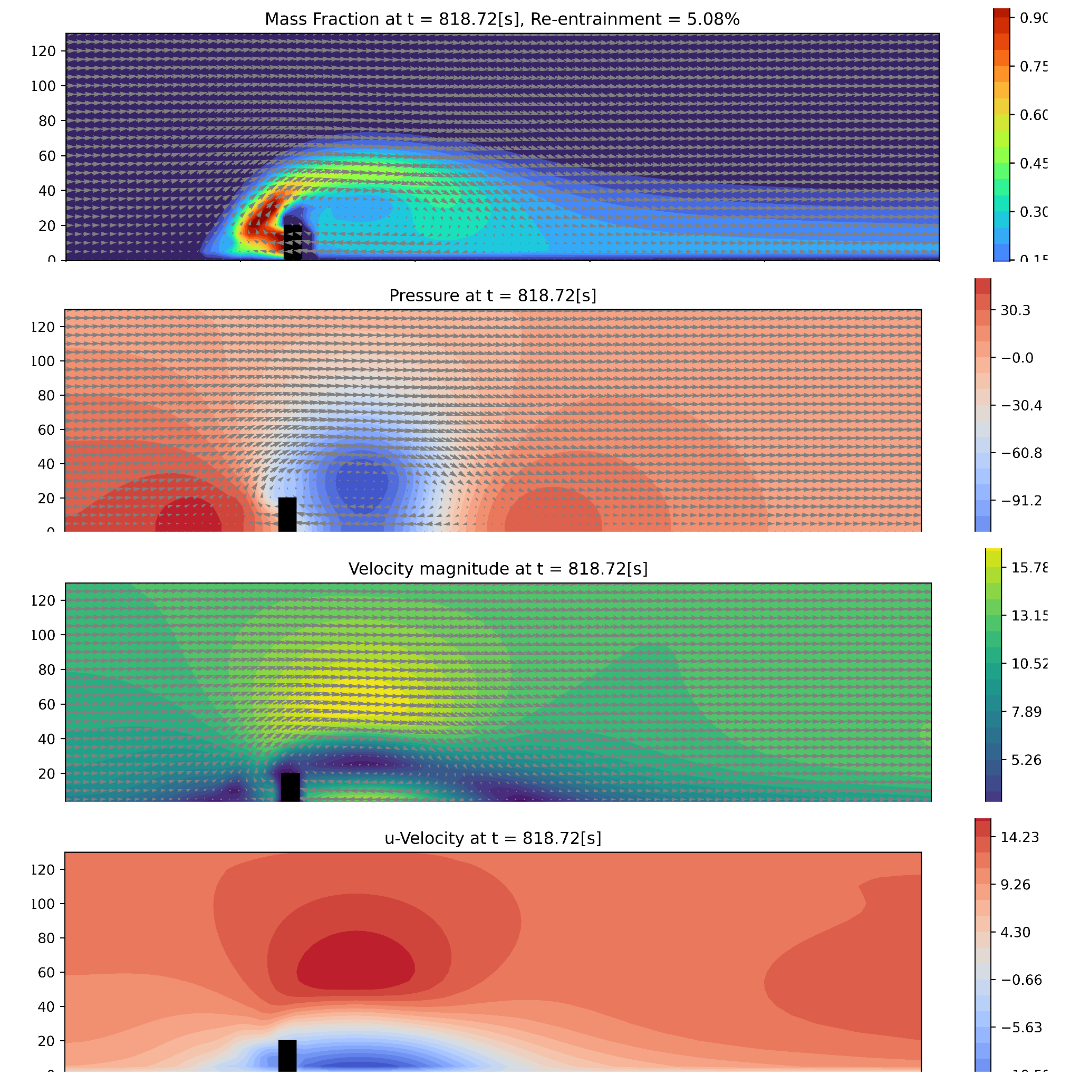
10x20 and 8x25 configurations minimized re-entrainment to 5.08% and 7.03%, demonstrating enhanced decarbonization efficiency.
-
Wider configurations like 20x10 resulted in higher re-entrainment (11.68%), highlighting geometry's critical role in airflow management.
-
Achieved streamlined velocity fields and reduced turbulence in taller structures, validating computational efficiency.
Future Scope
-
Expand simulations to 3D geometries and dynamic wind conditions for more robust predictions.
-
Explore hybrid configurations combining tall cores with optimized outlet designs for balanced efficiency and feasibility.
-
Develop predictive tools using AI for real-time optimization of building designs under varying environmental conditions.
-
Collaborate with multidisciplinary teams to translate findings into practical applications.